
A recognised holder.
Establish which state represents the possession, who controls it and which successor is recognised after a transfer.
A digital possession should have a clear owner, a defined way to transfer it and a device that respects the change. INTEGYRS is building the connection.
Working software alpha. Private-node experiments recorded. Protected-device integration is a development milestone.
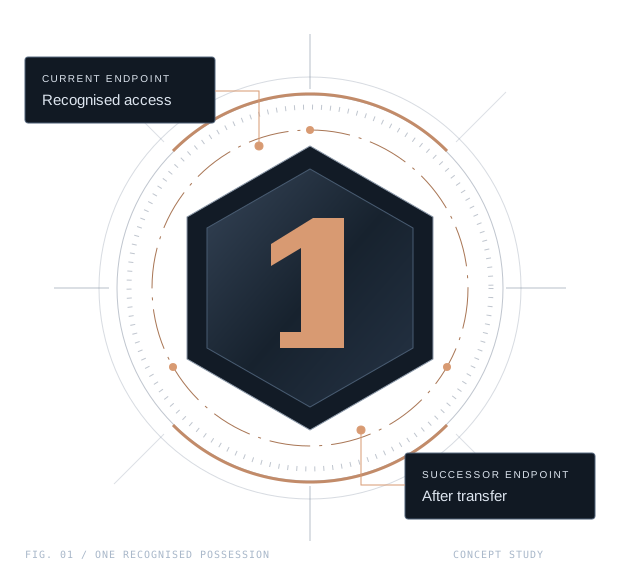
Files are easy to copy. A transferable digital possession also needs a recognised ownership state, a rule for fresh access and an endpoint that can enforce that rule.
Establish which state represents the possession, who controls it and which successor is recognised after a transfer.
Check eligibility when a section is requested. A change in ownership must change the previous holder’s next access decision.
Work toward protected processing and rendering. A software policy alone cannot keep secrets from a compromised host.
Our first program connects an ownership record to threshold-controlled access. Transfer is a sequence with defined hold, refusal and recovery states.
Walk through the lifecycleCreate a possession state. Keep its encrypted content separate from the ownership record.
Use fresh eligibility evidence and recipient-bound contributions for section access.
Stop new seller authorizations at the defined freeze boundary while the handover is resolved.
Recognise the successor and test that the previous holder’s later access is refused.
Concept sequence. The current implementation is experimental software; protected-device enforcement remains to be demonstrated.
Our recorded experiments cover successful transfers and deliberate failures. Each result belongs to a specific environment and version. Test counts are coverage records, not security scores.
The first intended experience is simple: a rights-cleared digital publication, a recognised holder and a transfer between two approved endpoints.
Explore the first use caseTransferable publications, licensed professional materials and device-bound software entitlements are candidate uses. Each needs its own rights, security and commercial validation.
Possession in a technical system does not itself transfer the copyright in the underlying work.
Hardware design work is underway. The next challenge is to turn a clear software access rule into a measured, protected device path.
See the product roadmapAuthenticated state, adversarial failure paths and reproducible recovery.
Attestation, non-exporting processing, protected rendering and rollback resistance.
Independent review and controlled pilots, with beta targeted for early 2027 and live rollout planned by April 2028.
Explore what digital scarcity changes, how the current protocol works, and the infrastructure, hardware and published inventions behind the longer-term direction.
Copyable files, transferable authority, least-privilege use and the potential to reduce host-visible information exposure.
Read the foundations → CHAPTER 01 / SOFTWARE MODELMinting, independently encrypted sections, threshold contributions, two fresh observations and the exact receipt/freeze boundary.
Read the protocol → CHAPTER 02 / DEVICE DESIGNCompeting threshold providers and compulsory hardware, fixed trust anchors, protected unit processing and the hostile-host test plan.
Read the hardware architecture → CHAPTER 03 / INFRASTRUCTUREDistributed transaction-processing services, state and storage, throughput context and the separate rates of settlement and device use.
Read the scalability analysis → CHAPTER 04 / PUBLISHED RECORDSEight linked US patent grant publications covering related key, recovery, credential, content and exchange mechanisms.
Read the patent register → ASSURANCE / ADVERSARIAL MODELCurrent software limits, future device guarantees, collusion, output leakage, privacy and the obligations created by recovery.
Read the security model →