
INTEGYRS
Voting / Research & engineering

Verify the election.
Protect the choice.

Encrypted ballots. Independently checkable evidence. A BSV Script state machine. INTEGYRS is developing the boundaries that connect these components without publishing an individual voter’s selection.

EXPERIMENTAL PILOTOFFLINE ZERO-KNOWLEDGE PROOFSBSV SCRIPT DESIGN

Separate the identity,
the ballot and the evidence.

The proposed system separates election configuration and eligibility from encrypted ballot handling, public evidence and tally verification. These are distinct responsibilities, not interchangeable guarantees.

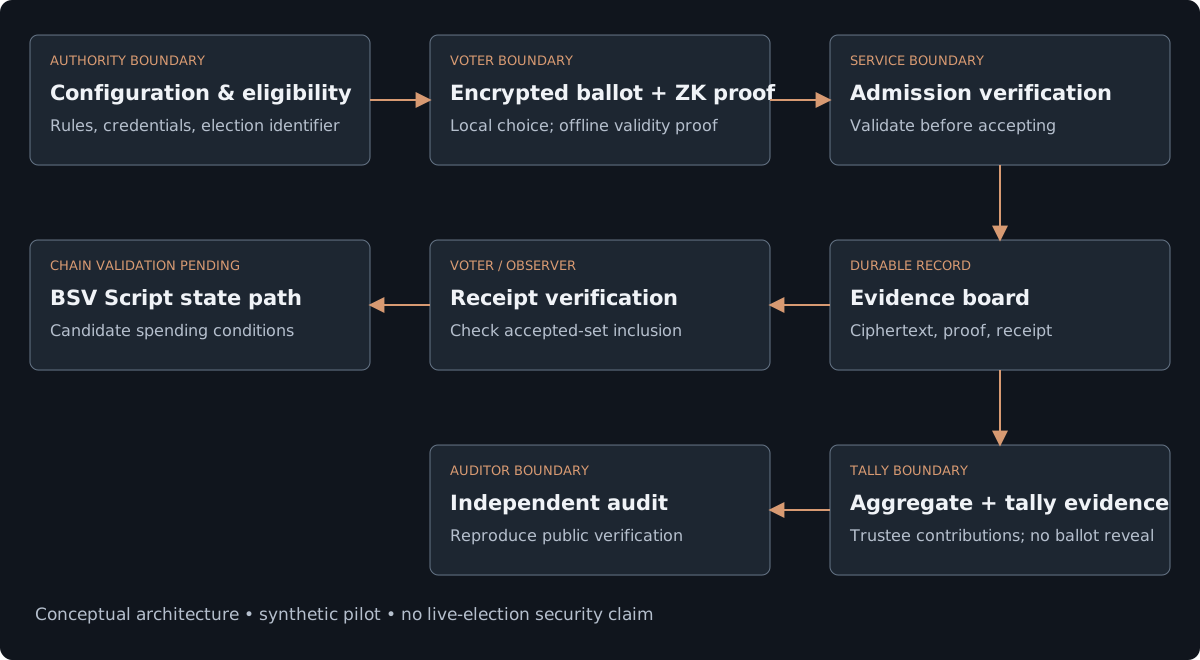
Architecture: election configuration and eligibility lead to a local encrypted ballot and proof, then admission verification and an append-only evidence board. A receipt verifier checks board inclusion. Aggregate tally evidence passes to an independent auditor. A separate BSV Script state path connects accepted election state to chain verification.
Proposed system boundaries, illustrated afresh for INTEGYRS. A public board publishes ciphertext and evidence, not plaintext selections. Application acceptance, chain inclusion and chain finality must be checked separately.

Modern credentials.
A separate private ballot.

The design moves beyond telephone-based registration and verification. Candidate approaches include internet identity checks, cryptographic credentials and remote video-assisted eligibility checks.

PROPOSED / NOT IMPLEMENTED

Verify eligibility online

Assess credential issuance, authentication and, where appropriate, a remote identity proctor. Identity checks must have explicit consent, accessible alternatives, minimal retention and a documented fraud and recovery policy. No provider integration or biometric assurance is claimed.
SEPARATION REQUIREMENT

Keep observation away from voting

A proctor may help check identity or eligibility, not watch the voter select or cast a ballot. Identity records, video sessions and device metadata must not be joined to the private ballot. Credential unlinkability and this separation remain design and validation requirements.

01

Encrypt locally.
Prove validity.

The pilot uses ElGamal encryption and Chaum–Pedersen-style zero-knowledge proofs for a synthetic single-choice election. Offline proof verification can check that a ballot encodes an allowed choice without decrypting that individual ballot.

This establishes a particular mathematical statement. It does not establish anonymous eligibility, a trustworthy voter device, or that the ciphertext matches the voter’s intent.

02

Record evidence.
Check the tally.

The application services separate ballot intake, proof verification, a durable SQLite evidence board, public tally auditing and a chain boundary. Receipts support checking inclusion in the accepted evidence set.

Homomorphic aggregation and tally proofs target independently reproducible counting without releasing individual plaintext ballots. Trustee key custody, deployment independence and production hardening remain separate work.

03

Enforce transitions.
Use BSV Script.

The chain design uses spendable BSV outputs and locking/unlocking scripts to constrain permitted election-state transitions. The intended mechanism is executable spending conditions, rather than an OP_RETURN record presented as enforcement.

Offline zero-knowledge verification and Script enforcement have different jobs. The design must specify exactly which predicates run in Script and which rely on an external verifier. Candidate scripts and local fixtures do not establish acceptance by a BSV node or live-chain finality.

A receipt is evidence.
It must not become a vote sale.

The desired verification experience lets voters check their participation without giving a third party transferable proof of their selection. That is an additional security requirement, not an automatic property of encryption.

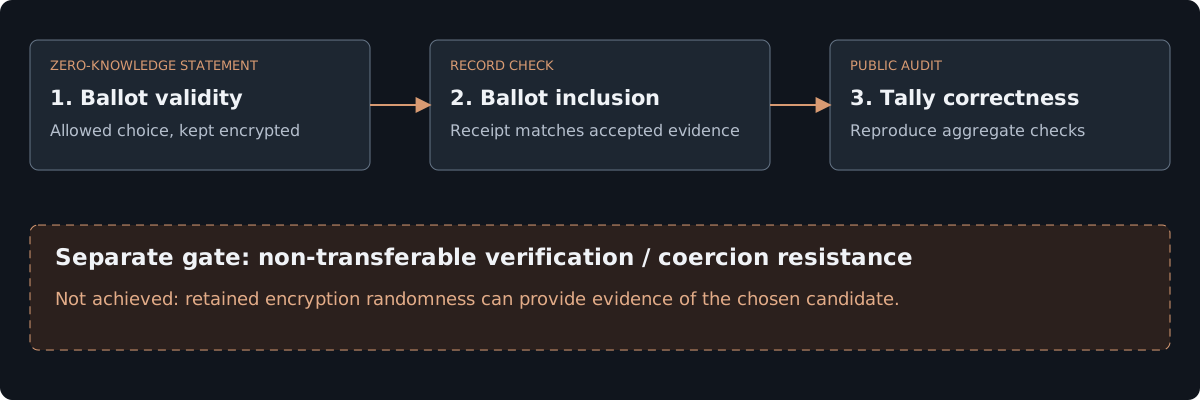
Verification ladder: prove that an encrypted choice is valid; check that the accepted ballot is included; reproduce the aggregate tally. A separate unresolved gate is non-transferable choice verification and coercion resistance.
Validity, inclusion, tally correctness and receipt-freeness are separate claims. The current experimental construction does not satisfy the final gate.

Make every claim
testable.

This is a research and engineering pilot, not an election service. No binding election, deployment certification or end-to-end election security is claimed.

IMPLEMENTED EXPERIMENT

Ballot proof & audit core

Local encryption, proof verification, evidence handling and independent tally checks for synthetic single-choice fixtures. Service separation is an implementation boundary, not proof of independent operation.

DESIGN / VALIDATION PENDING

BSV spending conditions

Proper Script-based state transitions require node execution tests, negative witness tests, transaction-policy checks and explicit chain observation rules before a chain-enforcement claim.

UNRESOLVED SECURITY REQUIREMENT

Non-transferable verification

A voter who retains encryption randomness can demonstrate a choice to another person in the current construction. Receipt-freeness and coercion resistance are not achieved.

!

Eligibility
and privacy

Pseudonymous test credentials are not anonymous eligibility. Metadata linkage, compromised devices, duplicate credentials, trustee collusion and retained secrets all require a complete threat model.

→

Next acceptance
gates

Specify the Script/offline-verifier boundary; execute the spending path against a BSV node; test recovery and concurrent submissions; define anonymous eligibility and non-transferable verification; commission independent cryptographic and operational review.